
The Future of Work: Where Is the Human in the Loop?

Designing AI adoption that strengthens performance, expertise and accountability
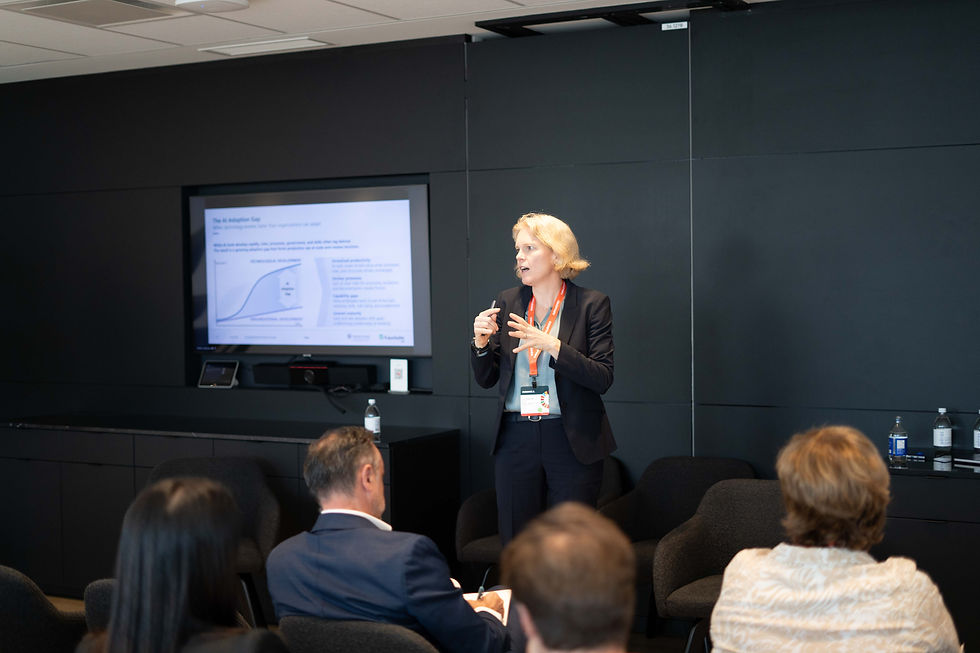
Five-minute synthesis of the workshop led by Professor Katharina Hölzle at the HUMANE.S. Summit on September 18, 2026. Hölzle is Director of the IAT at the University of Stuttgart and Managing Director of Fraunhofer IAO.
AI can improve immediate performance without strengthening the capabilities that sustain it. Employees may produce better work while learning less, accepting incorrect answers or becoming increasingly dependent on automated assistance.
This tension framed the workshop led by Professor Katharina Hölzle. Drawing on research and organizational practice, she examined how leaders could capture AI’s benefits while preserving human judgment, collaboration and expertise.
Her central proposition: successful adoption requires deliberate decisions about how work is allocated, how competence develops and who remains accountable.
Productivity gains require a more demanding definition of success
The research Hölzle presented documented meaningful gains from AI-assisted work, often with larger benefits for less experienced or initially lower-performing employees. Yet greater output does not consistently imply better quality or stronger organizational capacity.
During the workshop, she brought together findings that illustrated these distinctions:
Experiments involving approximately 5,000 software developers reported more completed tasks, alongside a decline in build success rates.
Research covering more than 12,000 European businesses reported productivity gains without adverse employment effects, with benefits dependent on complementary infrastructure.
US payroll research identified declining employment among younger workers in AI-exposed occupations.
These studies examine different populations and outcomes. They support separate assessments of throughput, quality, employment and capability development, rather than a single measure of productivity improvement.
For leadership: an AI investment should demonstrate how additional output translates into value after errors, rework, supervision and workforce consequences are considered.
Allocate work according to the task, its risks and the expertise required
Hölzle introduced the “jagged frontier”: AI performs effectively on some tasks and poorly on others, including tasks that appear closely related.
This uneven capability makes blanket decisions about automating entire roles unreliable. Work requires examination at the task level, distinguishing dependable delegation from collaboration and activities requiring human judgment.
ADD SCHEMA
Hölzle also challenged an approach focused exclusively on replacing existing activities. She asked what people could accomplish with AI that would otherwise be impractical.
That question broadens the investment agenda to include new services, expanded expertise and additional organizational capacity.
Organizational readiness is falling behind individual use
Employees can begin using AI faster than their organizations can adapt their processes, roles and governance.
Hölzle cited Canadian figures showing that 36% of workers had used generative AI at work during the preceding year, while approximately 19% of businesses reported AI use. These measures concern different populations and definitions; they illustrate a readiness challenge rather than a directly comparable adoption rate.
She identified four consequences of the gap between technological and organizational development:
Unrealized value: tools are introduced while workflows remain unchanged.
Unclear authority: autonomy, escalation and documentation are insufficiently defined.
Capability gaps: employees lack skills, role clarity or suitable support.
Uneven maturity: teams develop incompatible practices.
ADD SCHEMA SI APPLICABLE
For leadership: the question is whether individual experimentation is becoming a repeatable, governed organizational capability.
Better assisted performance does not establish durable competence
The distinction between what employees produce with AI and what they understand independently has significant implications for workforce development.
Hölzle discussed a three-month study involving 133 patent lawyers. AI improved work quality, but subsequent unaided testing showed a retained advantage only among senior lawyers. Juniors showed no average gain.
She used this finding to emphasize the importance of foundational expertise: employees need sufficient knowledge to interpret assistance and convert practice into lasting learning.
Other studies discussed during the workshop reported high acceptance of incorrect AI answers, reduced peer advice under algorithmic management and work intensification.
These findings are specific to their research settings. Collectively, they support a broader leadership responsibility: monitor how AI affects judgment, knowledge exchange and workload, alongside the volume of work completed.
5. Learning must be integrated into the operating model
Hölzle presented an enablement model addressing toolset, skillset and mindset, with development at three levels:
Level | Capability to develop |
Basic literacy | Understand AI, integrate it into everyday work and apply legal and ethical guidance |
Advanced literacy | Develop use cases, redesign task sequences and allocate work between people and AI |
Strategic literacy | Redesign roles, workflows and processes while addressing responsibility and skill erosion |
The practical formats she described included experimentation spaces, workshops built around employees’ own cases and peer-learning communities. These approaches connect learning to actual work and help employees understand why an approach succeeds or fails.
She also outlined dedicated development for leaders in quality assurance, compliance, human–AI leadership and changing expertise requirements.
The maturity of these initiatives varied. At the time of the workshop, the AI mentor was a prototype, and the leadership academy was scheduled to begin on October 22, 2026. Results from that academy were therefore not part of the evidence presented.
Four decisions define the leadership agenda
Hölzle concluded the workshop with four priorities:
Anchor learning in real tasks. Connect development to the work employees actually perform.
Assess competence separately from output. Verify that people can understand and evaluate AI-assisted results.
Separate generation from judgment. Define how suggestions are evaluated and who decides what proceeds.
Determine what remains human. Make expertise, responsibility and human contribution explicit organizational choices.
For executives and boards, these priorities translate into a practical review framework:
Question | Strategic concern |
Do gains persist after quality and rework are considered? | Economic value |
Can employees independently evaluate AI-assisted work? | Retained expertise |
How will junior employees develop foundational skills? | Future workforce capacity |
Who owns decisions, exceptions and escalation? | Accountability |
What is happening to collaboration and workload? | Organizational health |
Hölzle positioned corporate learning as an essential component of organizational transformation. Its purpose extends to developing people who can work effectively with AI, challenge its outputs and remain responsible for the decisions that follow.
Based on the workshop slides and the research cited within them. Diagrams are editorial syntheses, not reproductions of the original figures.
Comments